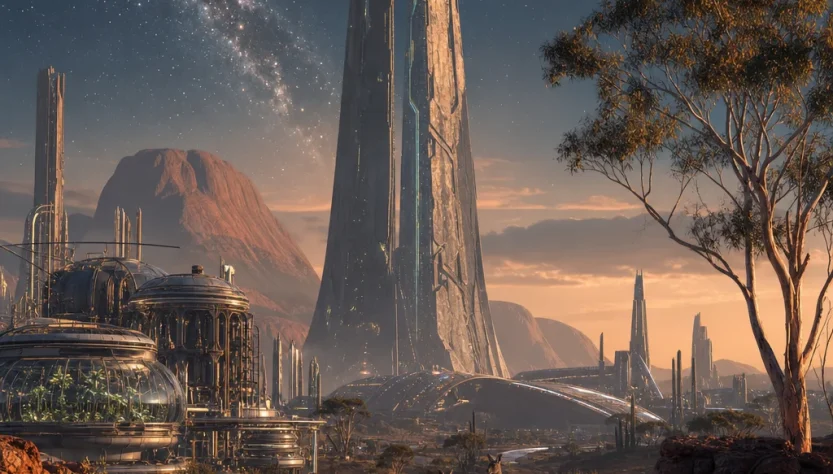
A Continent That Imagined the Future Early
Australian speculative fiction rarely announces itself with fanfare. It arrives quietly — through a short story in a small magazine, a novel picked up by an overseas editor, or a film that becomes a global reference point before anyone checks the director’s passport. Yet the cumulative effect on world literature is remarkable. A country of roughly twenty-seven million people has produced hard science fiction that reshaped the genre’s technical ambitions, fantasy sagas that sold millions of copies in translation, and enough editors, reviewers and convention organisers to keep the field’s machinery running across multiple continents. Understanding that contribution means looking past a handful of famous names and examining the conditions that produced them: geographic distance, isolation, a harsh landscape, a stubborn readership, and a national literary habit of asking what happens when social and ecological systems fail completely.
Bush Gothic and the Colonial Imagination
The earliest Australian speculative writing grew from the settler experience of a landscape that felt profoundly alien and unreadable. Nineteenth-century readers devoured tales of ghosts, lost civilisations and strange creatures beyond the settled districts, and writers such as Marcus Clarke and Rosa Praed worked that territory with relentless psychological intensity. Clarke’s convict-era masterpiece For the Term of His Natural Life traded in existential dread rather than simple wonder; Praed mixed spiritualism with deep-seated colonial anxiety. These were not science fiction in the modern sense, but they established a template that never quite disappeared: the natural environment as an active participant, indifferent and possibly hostile, and human civilisation as a thin membrane stretched over something ancient and utterly incomprehensible.
That inheritance shaped narrative tone for more than a century. Where American pulp fiction celebrated boundless expansion and manifest destiny, Australian writing more often asked what expansion actually costs and who pays the price. The outback became a literary device for testing characters against absolute emptiness, and the bush became a place where rational explanation quietly gives way to the uncanny.
Magazines, Fandom and the Machinery of a Genre
Speculative fiction does not survive on novels alone; it requires thriving short fiction markets, and Australia built them with fierce dedication. Aurealis, founded in 1990, became one of the English-speaking world’s longest-running venues for Australian and international speculative short fiction, publishing early work by writers who later dominated global bookshop shelves. Andromeda Spaceways Inflight Magazine followed as a cooperative venture run by its own contributors, an unusual model that mirrored the field’s do-it-yourself ethos. Alongside them ran independent small presses, influential fanzines, and convention committees that treated genre publishing as a community-driven cultural project rather than a speculative market opportunity.
The awards structure reinforced this robust ecosystem. The Ditmar Awards, voted upon by members of the national science fiction convention, recognise exceptional achievement in writing, editing, art, and fan work. The Aurealis Awards, first presented in 1995, split science fiction, fantasy, horror and young adult fiction into rigorous separate categories — a granularity that gave critics and reviewers a way to discuss Australian work on its own terms. Meanwhile, the Australian Science Fiction Foundation and state-based writers’ groups ran workshops that consistently turned enthusiastic readers into technically accomplished authors.
The international proof of this maturity came in 1975, when Melbourne hosted the World Science Fiction Convention, marking the first time the event was held in the Southern Hemisphere. A second Melbourne Worldcon in 2010 repeated the feat on an even grander scale. The bidding, organising and volunteering behind those events demonstrated an institutional capacity and international reach that smaller literary scenes rarely manage to muster.
The Hard Science Fiction School and Conceptual Rigor
If Australia has a signature export within the global genre, it is rigorous, idea-driven hard science fiction. George Turner’s The Sea and Summer, published in 1987, imagined a flooded, socially stratified Melbourne and won international acclaim for treating climate change and extreme class division as severe engineering and political problems rather than mere atmospheric metaphors. Turner wrote as a literary realist who happened to use futuristic premises, and his late novels pushed Australian SF into the realm of high intellectual seriousness.
Then came Greg Egan. Working from Perth with little interest in self-promotion or the trappings of celebrity, Egan produced novels and short stories that treated mathematics, quantum physics, and philosophy as first-order narrative material. Masterpieces such as Quarantine, Permutation City, Diaspora, and Schild’s Ladder built sprawling universes out of theoretical physics, artificial consciousness, and cutting-edge cosmology, setting a global benchmark for conceptual ambition that writers worldwide still measure themselves against. His influence operates less through stylistic imitation than through pure permission: he proved to the publishing world that readers will eagerly follow an author into genuinely difficult, mathematically complex territory if the ideas are worked out with absolute intellectual honesty.
Others walked a related path with distinction. Sean Williams combined hard science fiction with major franchise work while producing critically lauded original novels such as The Resurrected Man. Damien Broderick successfully moved between avant-garde fiction and high-level science commentary. This intellectual tradition continues today in writers like Jane Rawson, who bends contemporary ecological anxiety into haunting, speculative literary forms.
The Fantasy Boom and the Young Adult Bridge
Fantasy proved to be the commercial breakthrough that brought Australian speculative authors onto global bestseller lists. Isobelle Carmody began publishing her epic Obernewtyn Chronicles in the late 1980s, and the series’ intricate blend of psychic power, post-apocalyptic ruin, and complex adolescent agency found dedicated readers across multiple generations. Sara Douglass’s Battleaxe launched a sprawling historical fantasy epic in 1995, proving definitively that an Australian author could dominate markets in the United States and Europe without relocating overseas. Trudi Canavan’s Magicians’ Guild books repeated this pattern a decade later, leaping seamlessly from local independent publication to massive international sales.
Young adult fiction became the crucial literary bridge, allowing Australian writers to reach global readerships across dozens of international markets simultaneously. Garth Nix’s Sabriel, published in 1995, presented a breathtaking world of necromancy, magic, and institutional bureaucracy rendered with a chilling precision that made the fantastical feel completely and administratively real. Alison Goodman followed with works that blended historical romance with demonic investigation, further cementing the country’s reputation for innovative cross-genre storytelling.
Indigenous Futurisms and Global Horizons
In recent years, the most vital evolution in Australian speculative fiction has come from Indigenous writers who are actively reclaiming and reinventing the genre through Indigenous futurisms. Authors such as Claire G. Coleman, author of Terra Nullius, use speculative frameworks to expose the deep historical traumas of colonisation, reframing frontier history as an alien invasion narrative. Ellen van Neerven weaves speculative ecology, queer identity, and ancestral connection into short fiction that challenges traditional Western assumptions about time and progress. These storytellers demonstrate that speculative fiction is not merely an escape from reality, but a powerful instrument for interrogating power, identity, and survival.
From the early colonial dread of Marcus Clarke to the quantum mathematics of Greg Egan and the decolonial visions of modern Indigenous writers, Australia’s contribution to global speculative fiction is profound. It is a body of work defined by an unflinching willingness to gaze into the abyss of environmental and social collapse, extracting from that isolation some of the most intellectually daring and formally inventive literature written anywhere in the world.