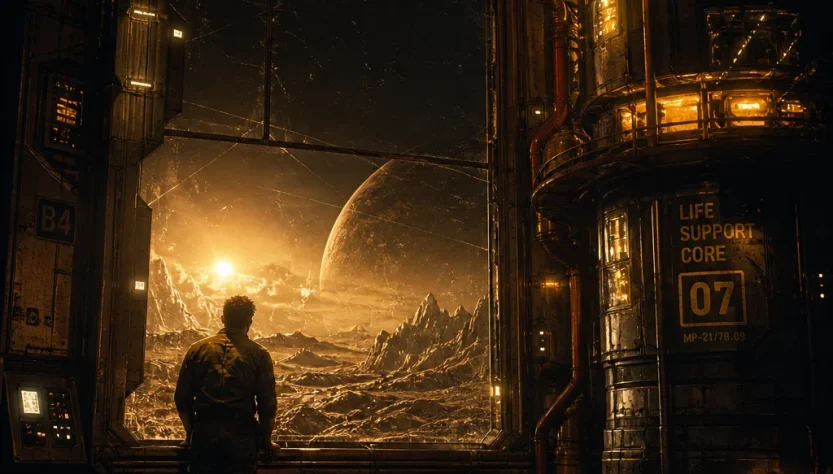
Space colonisation has long been marketed to humanity as the ultimate escape hatch. When planetary ecosystems collapse, resources dry up, and political systems curdle into endless conflict, the narrative promises that we can simply pack our bags, leave the cradle of Earth, and start over on a pristine frontier. Yet, dystopian literature has spent the last century relentlessly interrogating that promise, returning with answers that are deeply unsettling. From the sealed biospheres of mid-century speculative fiction to the corporate-owned orbital stations of contemporary narratives, the space colony invariably turns out to be less a fresh start and more a magnifying glass held up to our worst terrestrial failures.
The philosophical dilemmas embedded in dystopian space colonisation are not fundamentally about rocketry, propulsion, or life-support physics. They are rooted in political philosophy: scarcity, informed consent, intergenerational inheritance, and the terrifying question of who writes the rules when there is no longer a geographical horizon to escape toward. Strip away the titanium bulkheads and airlocks, and you are left with the oldest debates in human history: who belongs, who decides, who pays the human cost, and what happens to those who say no.
The Closed Habitat as a Moral Laboratory
Terrestrial dystopias always retain an escape valve. A political dissident can slip across a border, vanish into the wilderness, or join an underground resistance. A sealed habitat in the void completely eliminates that valve, which is precisely why authors are drawn to it. Once the walls are hermetically sealed and the oxygen supply is strictly metered, every socio-political decision transforms into an absolute absolute.
A curfew ceases to be an inconvenience and becomes an immediate threat to survival. A food ration is no longer a matter of economic policy, but a direct body count. This architectural and environmental compression makes the space colony an extraordinarily efficient philosophical instrument. It forces authors to strip away societal hypocrisy and state their premises in neon letters. If an author believes that absolute hierarchy is essential to survival, a Martian habitat will theoretically prove it. If another believes in inherent human cooperation, the same sealed tin can will test that hypothesis to its breaking point. The setting doesn’t resolve the debate; it simply mutes the external noise that usually obscures it.
Selection Bias and the Ethics of the Passenger List
Almost every colonisation narrative opens with a bureaucratic bottleneck: the list. Someone must select the engineers, physicians, agronomists, and pilots, and someone must explain to the vast majority left behind why they are condemned to a dying world. Dystopian fiction rarely permits this selection process to remain innocent. The passenger manifest invariably becomes an instrument of class preservation, political loyalty, racial bias, and genetic sorting masked as public health initiatives.
This raises an agonizing ethical question: can a selection process ever be morally sound when survival stakes are absolute? A pure utilitarian might argue that maximizing the colony’s survivability justifies ruthless triage and eugenic screening. A Kantian philosopher, however, would insist that no human being may ever be treated merely as a means to a collective end, no matter how noble the survival of the species might be. Novels that lean into the utilitarian calculus frequently conclude in quiet, chilling horror, forcing the reader to realize they have been cheering for an authoritarian eugenics program wrapped in a space-agency flag.
Generation Ships and the Tyranny of the Unborn
The generation ship represents the purest and most acute test case within the genre. The original crew may board the vessel voluntarily, but their children, grandchildren, and great-grandchildren are born into a moving cage without ever giving consent. They inherit an artificial world with a fixed trajectory, a predetermined purpose, and a legal code drafted by ancestors they will never meet.
Is this intergenerational inheritance fundamentally different from the one infants receive on Earth? Perhaps only in its naked visibility. On a generation ship, the social contract is physically welded into the corridor walls. Several speculative novels push this premise further by depicting later generations who reject the mission entirely. Do they owe absolute obedience to dead founders? Can a society engineered strictly for arrival survive the devastating realization that there is nothing left to arrive at? The recurring mutiny trope in these stories is never just an action set-piece; it is the inevitable collision between inherited obligations and present-tense human freedom.
Scarcity, Rationing, and the Reinvention of Caste
An economy on a space station or extra-solar colony is a moral document written in consumption rates. Water, caloric intake, breathable air, data bandwidth, and personal square footage must be allocated somehow—by market forces, by lottery, by demonstrated need, or by raw power. Dystopian writers are deeply skeptical of market-driven allocation in space, recognizing that a colony which prices oxygen is a place where the impoverished simply stop breathing.
More compelling narratives bypass cartoonish villains to show how emergency rationing quietly hardens into permanent hereditary castes. Temporary crisis powers become institutionalized fixtures of governance. The administrators who manage the water-recycling plant acquire de facto veto power over human life. Children grow up internalizing the queue as a law of nature, believing that the color of their access wristband reflects their biological worth. The ultimate horror is not overt tyranny, but how rapidly systemic oppression becomes mundane, leaving subsequent generations unable to recall that things could ever have been otherwise.
Corporate Sovereignty and the Extraterrestrial Frontier
Modern dystopian fiction has largely traded the totalitarian nation-state for the hyper-efficient interstellar corporation. A private mega-corporation funds the launch, manufactures the habitat module, leases the regolith, and employs the private security forces acting as judiciary and executioner. The residents are not citizens with constitutional rights; they are temporary contractors bound by exhaustive terms of service.
This is not wild fantasy, but a direct extrapolation of contemporary legal frameworks surrounding special economic zones and corporate offshore platforms. The core philosophical crisis is that a corporation possesses no legal or moral obligations beyond maximizing shareholder value. It cannot honor a social contract it never signed. When the sole hospital, the single airlock, and the only food synthesizer are owned by a single commercial entity, the concept of human rights dissolves into a corporate arbitration hearing. These works use space not to explore the cosmos, but to lay bare the logical conclusion of privatizing the fundamental conditions of human existence.
Terraforming and the Moral Status of Dead Worlds
Terraforming introduces one of the sharpest ecological dilemmas in speculative fiction. If a target planet harbours subterranean microbial life or an ambiguous, fragile ecosystem, the colonists must decide whether to preserve it in its native state or aggressively overwrite it with an engineered Earth-like biosphere. Terrestrial environmental ethics has long debated the intrinsic value of nature; terraforming transplants that debate to an arena where the consequences carry civilisational weight.
Two stark philosophical camps usually dominate. The first maintains that life, in any form, possesses intrinsic value that no human convenience can override. The second argues that human survival is the only defensible value without resorting to metaphysics, and that a sterile rock has no moral claim to its own desolation. Masterful novels refuse to offer neat resolutions, portraying any choice of terraforming as an irreversible original sin branded into the geology of a new world.
Memory, Language, and Epistemic Control
A space colony is essentially a cultural copy transmitted through an imperfect channel. Lexicons drift, religious dogmas fracture, historical records blur, and within three generations, settlers argue bitterly over what the mission’s founders actually intended. Dystopian narratives exploit this linguistic and cultural drift to show how easily founding ideals are hijacked. The charter guaranteeing emergency free speech becomes the legal justification for absolute censorship; the safety rule against resource hoarding transforms into a mandate for total surveillance.
The deeper epistemological anxiety centres on the control of history. Without physical archives, independent witnesses, or anyone who remembers Earth firsthand, a colony loses its baseline for objective reality. Whoever controls the historical database controls the future trajectory of the station. In several novels, the chief archivist emerges as the most dangerous figure on the station—not because they fabricate lies, but because they curate which facts are permitted to survive.
Ultimately, dystopian space fiction is not truly an expression of anti-science sentiment or a rejection of spaceflight. Rather, it is a profound warning against the naive belief that a change of geographic coordinates can substitute for a fundamental change in human politics. The colony serves as a literary stress-test, proving beyond doubt that institutional corruption travels inside our luggage, that hierarchies naturally replicate themselves, and that isolated populations are infinitely more vulnerable to tyranny than open, interconnected societies.
“