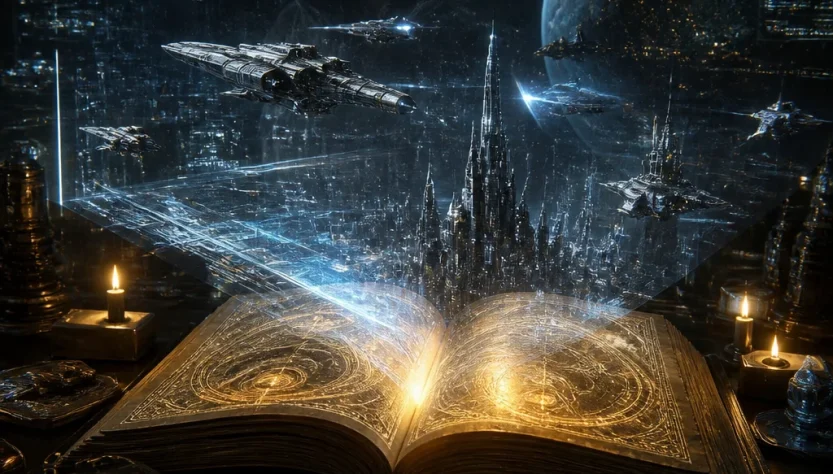
Science fiction has always been a genre that thinks in pictures. Long before cinema existed, writers were sketching alien landscapes, towering machines, and futures that felt close enough to touch. When film and television learned to render those visions, a conversation began that has never stopped. Printed books and screen media now trade ideas constantly, borrowing images, structures, and audiences from one another. Understanding that exchange helps explain why some stories survive for decades while others fade after a single season.
From Pulp Pages to Silver Screens
The earliest science fiction films borrowed heavily from literature, even when they did not credit it. German expressionist cinema took its visual grammar from stage design and illustrated magazines, while writers like H. G. Wells saw their ideas reshaped into spectacle almost immediately. By the middle of the twentieth century, studios had learned a simple lesson: a familiar title sells tickets faster than an unknown one. That logic created a steady pipeline from shelf to screen, and it also created a habit of adaptation that the genre has never escaped.
What changed over time was not the direction of the flow but its speed. A novel once took twenty years to reach theaters. Today a well-reviewed debut can be optioned before paperback publication, and a streaming platform can order a series from a short story that appeared in a digital magazine three months earlier. The gap between reading and watching has nearly collapsed, which means the two forms now influence each other in real time rather than across generations.
The Adaptation Problem: Interiority Against Spectacle
Science fiction depends on interior experience more than most genres. A writer can spend a page describing the sensation of a mind linked to a ship, or the slow dread of a crew realizing their mission is meaningless. Film has to externalize all of it. A thought becomes a conversation, a feeling becomes a lighting choice, and an abstract concept becomes a set piece that must be built and lit and paid for.
This is why the best adaptations are rarely the most faithful ones. Fidelity to plot often produces a flat movie, because plot is the least interesting thing a science fiction novel does. The successful adaptations are the ones that identify the emotional core of a book and rebuild everything around it, sometimes discarding entire chapters along the way. Screenwriters who treat the source as raw material tend to succeed. Those who treat it as scripture tend to produce museum pieces.
Dune and the Long Road of Repeated Attempts
No title better illustrates the difficulty of translation than Frank Herbert’s desert epic. Its dense politics, internal monologues, and ecological obsession defeated one ambitious director entirely, resulted in a divisive feature in the 1980s, and finally found a durable form in a two-part modern adaptation. Each attempt made a different bargain with the book. One chased the psychedelic interiority, one chased the grand myth, and one chased the physical scale.
The lesson is not that one version was correct. It is that a rich novel contains several possible films inside it. Herbert’s text is a political thriller, an environmental warning, a religious study, and an adventure story at once. A filmmaker picks one thread and pulls, and the result looks like a betrayal to readers who preferred a different thread. Adaptation is therefore always an act of argument, not just translation.
Blade Runner and the Reinvention of a Novel
Philip K. Dick’s novel about empathy and artificial animals became a film about atmosphere, rain, and neon. The adaptation kept the moral question at its center but discarded the domestic clutter that gave the book its strange humor. In return, it gave the world a visual language that now defines how the entire genre imagines a future city.
The interesting part came later. That visual language flowed back into publishing. Cover artists began painting rainy streets and glowing advertisements onto novels that had nothing to do with Dick’s original work. Publishers wanted readers to recognize the mood of the film, even when the book offered something completely different. Screen and page had swapped roles: the film was now teaching the book how to look.
The Streaming Era and the Return of the Long Novel
For decades, the biggest obstacle to adapting science fiction was length. Two hours is not enough time for a story about a civilization collapsing over centuries, or a trilogy about an empire expanding across a galaxy. Serialized television solved that problem, and streaming turned it into a business model. Suddenly the unfilmable became a prestige project, and long, difficult books started appearing in development slates next to crime thrillers.
This shift changed what publishers prioritize, sometimes in subtle ways. A novel with a strong central premise and a clear seasonal structure becomes more attractive than a formally experimental masterpiece. Agents mention it. Editors think about it. Writers, consciously or not, notice which books get bought and adapt accordingly. The screen has become a silent co-author of the modern science fiction novel.
Tie-In Fiction: When the Screen Writes Back
The influence has never been one-directional. Films and franchises spawned enormous libraries of novels, some of them genuinely excellent. Writers working in those universes produced detailed political histories, philosophical digressions, and character studies that would never have survived a studio pitch meeting. For millions of readers, tie-in fiction was a gateway into the genre itself, and it trained a generation to accept elaborate continuity as a normal part of storytelling.
Those books also served as a testing ground. Ideas that appeared first in a cheap paperback sometimes migrated into films once audiences had already accepted them. The relationship became a feedback loop in which novels acted as a rehearsal space for the screen and, occasionally, as its archive.
Covers, Tie-In Badges, and the Marketing of Recognition
Walk through any bookstore and the mechanics of this dialogue become obvious. Reissued novels wear film stills on their covers. A small badge announces the streaming release. Publishers strip the original art, sometimes the original title treatment, and replace it with faces of actors who will be forgotten in a decade. The book that arrives on shelves is not the book that was written; it is a book wearing a costume.
Readers complain about it, and they are right to, but the economic logic is hard to argue with. A recognizable image lowers the cost of a decision. The badge does not tell you what the book is. It tells you that other people have already agreed to care about it.
Fandom as Translator
Between the page and the screen sits a third participant that rarely gets named in the credits: the audience. Fans produce wikis, video essays, reading orders, and elaborate timelines. They argue about whether a character’s behavior matches the source, and in the process they translate the source for people who never read it. This unpaid labor shapes reputations and even influences creative decisions, because studios watch the conversation closely.
Fandom also polices fidelity, which is a strange standard for a genre built on imagining the impossible. The same readers who celebrate radical ideas often demand exact reproduction of a plot they already know. That contradiction is the engine of the whole cycle, and it will not be resolved any time soon.
Hard Science, Soft Emotion
There is a practical reason why books and screens excel at different flavors of the genre. A novel can spend two pages on orbital mechanics without losing a reader who came for the problem-solving. A film must cut those pages and find a way to make the physics visible and emotional within seconds. As a result, screen science fiction tends to foreground relationships and scale, while print science fiction tends to foreground mechanism and consequence.
Neither is superior. They are two different instruments playing the same piece. The genre is healthiest when both keep playing, and weakest when one dominates completely.
The Quiet Pipeline of Short Stories
Some of the most acclaimed screen science fiction came from short fiction rather than novels, and the reason is structural. A short story often consists of a single elegant idea with a sharp emotional turn at the end, which is almost exactly the shape of a feature film. A novel has too much furniture; a story has just enough plot to carry a concept and just enough space for a filmmaker to invent the rest.
This is why short fiction remains an essential part of the ecosystem even as magazine readership stays modest. It is the genre’s research laboratory. Novels are the archive, films are the exhibition, and short stories are where the experiments happen, unglamorous and essential.
What Pages Teach the Screen
Writers and directors consistently learn three things from prose. First, worldbuilding discipline: a good novel reveals a society through small details rather than an explanatory opening crawl. Second, patience: a plot can withhold answers longer than a nervous producer might prefer. Third, moral ambiguity: books are comfortable with characters who are neither heroes nor villains, and that comfort produces better drama than any number of save-the-galaxy climaxes.
The best adaptations import exactly these qualities and nothing else. They keep the texture and throw away the structure. When they succeed, viewers describe the result as richer than a typical blockbuster, without always realizing why.
What the Screen Teaches Publishing
The flow runs both ways. Contemporary novels are now written with an instinct for visual pacing, shorter chapters, and scenes built around striking images. Dialogue has become leaner, a habit picked up from television. Cover design borrows cinematographic terms from studio marketing. Even the structure of a trilogy has been influenced by what audiences now expect from a series.
None of this is automatically a loss. Popular forms have always absorbed techniques from each other, and the novel survived cinema, radio, and television without collapsing. What matters is that writers stay aware of which habits serve the story and which merely imitate a trailer.
The Spoiler Divide
Readers and viewers experience suspense differently. A reader can live inside a character’s uncertainty for pages; a viewer sees the uncertainty on a face for a few frames. That difference explains why some adaptations feel rushed to readers and slow to viewers, and why spoiler culture has become so fierce. For a reader, the pleasure is in the sentence. For a viewer, it is in the reveal.
Good adaptations find a third path. They preserve the tension without demanding ignorance, giving audiences a reason to watch even when they already know how it ends. That is much harder than it sounds, and it is why the most durable screen science fiction often diverges from its source in the final act.
A Global Conversation
Streaming has made this dialogue international. Novels translated from Chinese, Japanese, Polish, and Russian now reach global audiences and are adapted almost immediately, and those adaptations carry visual ideas back into publishing worldwide. A generation of readers is growing up encountering the same stories simultaneously in subtitles, dubs, and translated paperbacks.
That synchronization is new. Previous exchanges happened across decades and were filtered by local distributors. Today the loop is fast enough that a reader, a viewer, and a fan artist can all be responding to the same release within a week, and their responses feed into the next project.
Why the Dialogue Still Matters
Science fiction is a conversation about the future conducted in the present tense, and it has always used whatever medium is loudest. Printed books offer depth, interiority, and the freedom to be strange. Screen media offers scale, shared experience, and the emotional power of a face. Neither can do what the other does, and the genre is at its most vital when both are working well at the same time.
The next decade will bring more adaptations, more tie-ins, more covers wearing borrowed faces. Some will be cynical, some will be revelatory. The only reliable prediction is that the exchange will continue, because the underlying question never stops being urgent: what kind of future do we want, and who gets to describe it first.