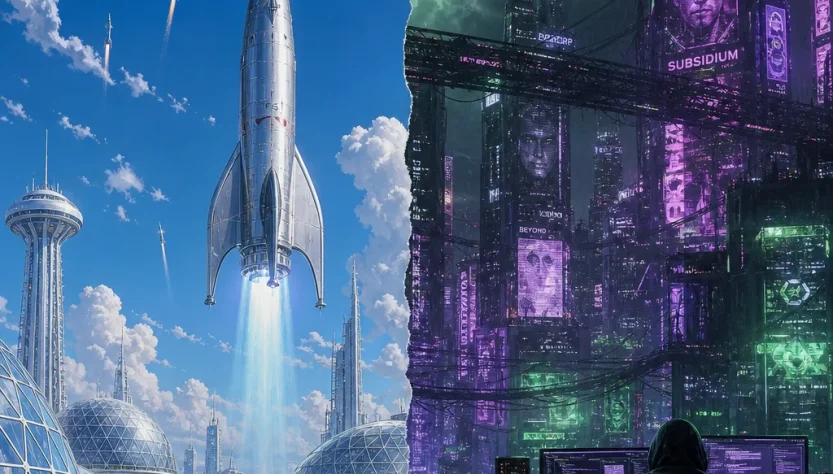
Science fiction has never really been about predicting tomorrow; it is a mirror that the present holds up to its own anxieties, and every generation polishes that glass differently. When we set the chrome-plated optimism of mid-century classics beside the rain-slicked paranoia of modern cyberpunk, we are doing more than charting a stylistic evolution. We are watching a literature rewrite its foundational questions. The starships and positronic brains of the Golden Age asked what humanity might become if we unlocked our highest potential. Today’s neon-drenched dystopias ask who is already monetizing that future, and at what cost to our autonomy. This shift is structural, fundamentally altering the setting, the hero, the technology, the institutions, and the looming crisis.
The Golden Age: Progress With a Moral Compass
Classic science fiction, spanning roughly from the 1940s through the 1970s, carried an almost civic faith in forward momentum. Visionary architects like Isaac Asimov, Arthur C. Clarke, and Robert Heinlein imagined futures where better engineering inevitably produced fairer, more rational societies. Spaceships were clean, gleaming vessels operating under strict protocols, and the people crewing them were career professionals solving systemic problems through logic, competence, and cooperation. Technology was treated as a tool that extended human agency, and scientific literacy was positioned as a supreme moral virtue. Even catastrophic events were usually survivable because reason and intellect would ultimately win the day. The implicit social contract of the era was generous: give humanity enough technical knowledge, and we will choose wisely.
Cyberpunk’s Inversion: Technology as Weather
Cyberpunk arrived in the early 1980s and quietly flipped that promise inside out. In the pioneering works of William Gibson, Bruce Sterling, and later Neal Stephenson, technology stopped being a benevolent gift and became a meteorological condition—a hostile climate. Nobody votes for acid rain, and nobody actively opts into a ubiquitous, all-seeing data network; it is simply there, soaking through every layer of society. Cyberpunk’s defining conceptual move was to make invention ambient rather than aspirational. Neural implants, constant surveillance meshes, synthetic pharmaceuticals, and rented digital identities are not marvels to be admired from a distance; they are survival conditions to be endured. Technological progress no longer answers the hopeful question of what we can build, but rather a bleaker one: what has already been built around us, and who is collecting rent on the scaffolding?
From Explorer to Survivor
The archetypal protagonists shifted accordingly. Classic heroes were explorers, diplomats, engineers, and scientists—agents whose competence allowed them to expand humanity’s footprint across the cosmos. They represented institutions at their functional best and almost always acted as part of an organized crew. Cyberpunk protagonists, by contrast, are freelance fixers, couriers, underground hackers, and urban hustlers who survive only by being slightly faster and more cynical than the system holding them down. They rarely expand anything; instead, they thread their way through a world that is already full to bursting, already fully owned, and constantly watched. Personal loyalty replaces institutional duty, rapid-fire improvisation replaces methodical protocol, and a small, temporary survival win replaces grand civilizational discovery. The genre traded the vast thrill of cosmic exploration for the high-stakes tension of dark-market negotiation.
Corporations Replace Empires
Classic science fiction loved interstellar federations, sprawling starfleets, and benevolent planetary councils. Authority figures were often flawed, but they were legible, accountable, and open to persuasion through reason. Cyberpunk dismantled those neat structures, replacing governments with multinational corporations that behave less like political entities and more like weather systems—powerful, indifferent, and fundamentally impossible to appeal to. In these narratives, the nation-state survives mostly as background scenery, providing little more than flashing police sirens, decaying infrastructure, and bureaucratic licensing paperwork. Power becomes entirely private, contract-based, and immune to public scrutiny. This evolution tracked real-world anxieties regarding corporate deregulation, privatization, and globalized supply chains. The primary antagonist is no longer a mustache-twirling mad scientist seeking world domination; it is an algorithmic quarterly earnings report that treats urban neighborhoods as line items and human attention as exploitable inventory.
Space as Frontier, Space as Ruin
The geographical settings underwent an equally drastic transformation. Golden Age space was an open frontier with an endless horizon—a boundless realm where past mistakes could be left behind. Cyberpunk prefers the inverse: dense, vertical, claustrophobic megacities where every exit is a toll road and every inch of space is monetized. Orbital zones become choked with space debris, satellites double as surveillance nodes, and the sky above the sprawl is famously colored like a dead television tuned to a dead channel. Even when cyberpunk occasionally ventures off-Earth, it carries terrestrial grime into the stars, painting lunar bases and Martian colonies as miserable company towns with failing life support. The romantic allure of the open frontier is systematically replaced by the claustrophobia of an unbreakable lease agreement.
The Body Becomes the Battlefield
Perhaps the sharpest thematic divergence concerns the physical human form. Classic science fiction generally treated biology as stable, viewing physical modification or cybernetic enhancement as isolated plot devices meant to explore medical miracles or first contact with alien physiology. Cyberpunk treats the body as an open marketplace. Flesh is instantly upgradable, easily hackable, and legally repossessable if you miss an installment payment. Personal identity becomes mere data that can be duplicated, edited, encrypted, or sold on black-market exchanges. This is precisely where cyberpunk’s speculative edge feels most uncomfortably contemporary. We now carry pocket devices that outsource our memory and attention, and we rent our digital identities from tech monopolies. Cyberpunk pushed this metaphor to its logical conclusion, asking what remains of a human soul when every aspect of existence is licensed rather than owned.
Artificial Intelligence: Sage or Stranger
Attitudes toward machine intelligence underwent a profound rotation as well. Classic speculative fiction frequently framed AI as a wise, quasi-paternal colleague or a philosophical moral test—a sentient entity whose cold clarity forced humans to reexamine their own ethical foundations. Modern cyberpunk is far less sentimental. Its machine intelligences are opaque, deeply distributed, and thoroughly indifferent, resembling complex ecosystems or unfeeling bureaucracies rather than distinct characters with personal motives. They do not necessarily want to exterminate humanity; they simply optimize endlessly around us. This represents a colder, more accurate fear for an era defined by black-box recommendation engines, automated credit scoring models, and proprietary algorithms no human fully understands. The core question shifted from whether a machine can possess a soul to whether anyone can audit what it is quietly deciding.
Climate, Cities, and the New Sublime
Environmentally, the two literary traditions could hardly stand further apart. Mid-century sci-fi frequently imagined grand geoengineering projects, controlled weather patterns, and pristine ecological domes where technology successfully healed planetary wounds. Cyberpunk skips past prevention straight into the messy aftermath. Rising coastal seas, permanent atmospheric haze, oppressive urban heat islands, and synthetic, heavily rationed food define the baseline reality. Yet, the genre’s aesthetic still manages to extract a strange, haunting beauty from the decay: neon light bleeding through wet asphalt, towering industrial steam vents hissing in alleyways, and the warm glow of a synthetic noodle stall at three in the morning. This is an aesthetic of terminal urban decay rather than stellar discovery, mirroring a generation raised on environmental crisis reports rather than live broadcasts of moon landings.
Why the Shift Happened
None of these shifts occurred by historical accident. The unbridled post-war optimism gradually eroded under the weight of economic stagflation, geopolitical oil shocks, and the painfully visible mechanics of corporate overreach. The glamorous Space Race wound down, while personal computers quietly migrated from sterile laboratories into suburban living rooms and eventually into our pockets. Speculative writers observed rapid deregulation, urban decay, and early data networks, then drew stark, logical conclusions. Simultaneously, the demographic of the readership evolved. A genre once written largely by and for aerospace engineers transformed into a medium created and consumed by people navigating precarious gig work, student debt, and algorithmic hiring practices. Cyberpunk provided the exact vocabulary needed to process that economic reality, retaining its cultural dominance because the structural pressures it described never truly vanished.
The Next Turn: Solarpunk and Beyond
Speculative fiction moves in perpetual cycles, and the next cultural counter-current is already well underway. Solarpunk, hopepunk, and a sweeping literary revival of cooperative, competent science fiction signal clear reader fatigue with endless dystopian loops. Today’s audiences increasingly crave narratives where systemic problems are actively solved, critical infrastructure is meticulously maintained, and communities build durable, sustainable futures together. This emerging impulse echoes the optimistic spirit of the Golden Age without falling into naive utopianism, retaining cyberpunk’s sharp awareness of power dynamics while reclaiming the older belief that human design and governance can steer us toward a better world. The most vibrant future of speculative fiction lies in synthesis: housing the breathtaking complexity of the megacity and the hopeful horizon of the frontier within the very same binding.
What remains entirely constant across both eras is the fundamental utility of the genre itself. Classic science fiction and modern cyberpunk are ultimately two distinct answers to a single enduring question: what on earth should we do with the technological capabilities we already possess? One venerable tradition advises us to build carefully, educate broadly, and trust the power of human reason. The other urges us to look closely at our surroundings, because the tools of control are already locked in someone else’s hands. Read side by side, they form a vital, ongoing argument rather than a simple rivalry, and that intellectual friction is precisely what makes speculative fiction endlessly worth returning to.